Root Rot: How to Spot It and Save Your Plant

Updated October 24, 2026
Brown, mushy roots mean root rot. If some firm, white roots are left, you can save the plant. Here's what to do today.
The fix, short version
- Slide the plant out and rinse the soil off the roots.
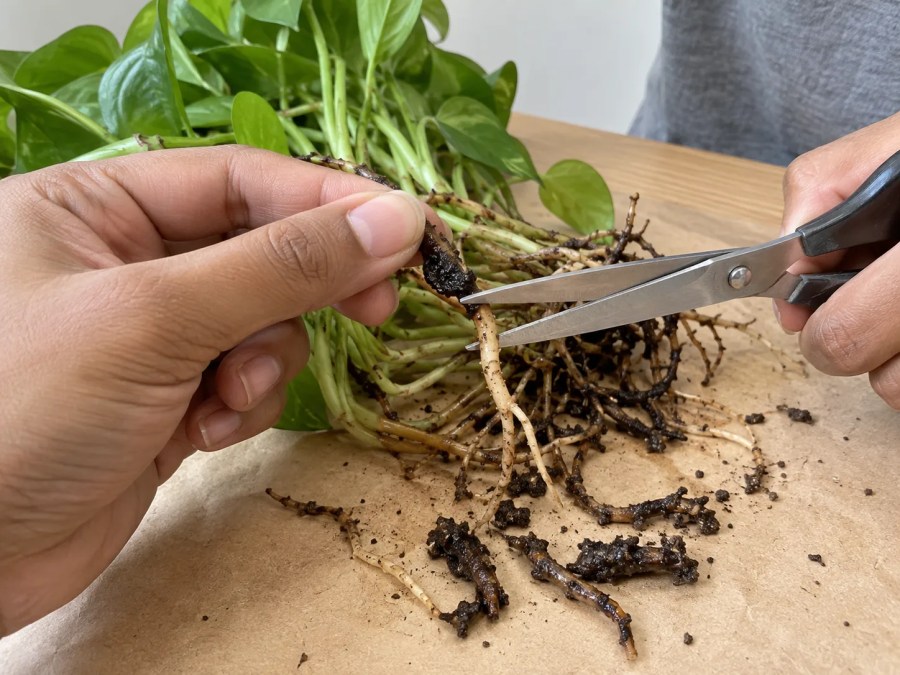
- Cut off every brown, mushy root with clean scissors.
- Bin the old soil. Replace plastic pots. Scrub clay ones in 1 part bleach to 9 parts water.
- Repot in fresh bagged mix, in a pot with a drainage hole, 1 to 2 inches (3 to 5 cm) wider than the roots.
- Water once, lightly. Then wait until the top 2 inches (5 cm) of soil are dry.
Is it root rot? Look at the roots
Leaves can fool you. A plant with root rot droops just like a thirsty one, so people water it more and make it worse. The roots tell you for sure, and checking takes two minutes.
Tip the pot on its side, hold the plant at the base of the stem, and ease it out. Then compare what you see.

Mostly brown or black, mushy, maybe smelly
Act today. Save what's still firm, or take a cutting if nothing is.
Go to the steps →Some brown, but mostly white and firm
You caught it in time. Trim the brown ones and repot in fresh mix.
Go to the steps →White or tan, and firm
Not root rot. Put it back and look for another cause, like low light, underwatering or pests.
Find other causes →Not sure about a root? Pinch it and pull gently. If the outer skin slides off and leaves a thin string behind, that root is dead.
Can't take it out of the pot? Tick what you see
Root rot often starts with the bottom leaves wilting, then moves up the plant.


The rule: if you tick 2 or more, there's a good chance it's root rot. Check the roots today.
1 sign. Probably not root rot yet. Let the top 2 inches (5 cm) of soil dry before you water again, and watch it for a week.
2 signs. There's a good chance it's root rot. Check the roots today, then follow the steps.
What causes root rot
Root rot is an infection. Water molds called Pythium and Phytophthora, and fungi like Rhizoctonia and Fusarium, live in soil and do best when it stays wet. Soggy soil has no air in it, the roots weaken, and these organisms move in. (UW-Madison Extension, Iowa State)
So the real problem is soil that stays wet for too long. These are the usual reasons:
- Watering on a schedule instead of when the soil is dry.
- No drainage hole, or a decorative outer pot that quietly holds water.
- Garden soil, or old potting mix that has packed down.
- A pot much bigger than the roots, so the extra soil never dries.
- Winter. The plant drinks less, but it still gets the same amount of water.
- Gravel at the bottom of the pot. It sounds like it should help drainage, but it actually holds water in the soil above it. University of Wisconsin plant scientists say to skip it.
Fungus gnats are worth knowing about too. They mean the soil is staying wet, and they can carry Pythium from one pot to the next. (Purdue Extension)
How to save a plant with root rot, step by step
Give yourself about 20 minutes and lay down some newspaper. You'll need:
- Clean scissors
- 70% rubbing alcohol
- Fresh bagged potting mix
- Perlite
- A pot with a drainage hole
-
Stop watering
Don't add water to wet soil, even if the plant looks thirsty. The drooping comes from damaged roots, not a lack of water.
-
Take the plant out
Tip the pot sideways. Squeeze a plastic pot, or run a butter knife around the inside of a clay one. Hold the plant at the base of the stem and ease it out. Don't pull it by the leaves.

-
Rinse the roots
Swish them in a bucket of room-temperature water until most of the soil falls away. Now you can see which roots are healthy.

-
Cut off the rotten roots
Cut anything brown, black, mushy or smelly back to firm, white tissue. Use the pull test above if you're not sure. Wipe the blades with 70% rubbing alcohol between cuts so you don't spread the rot to healthy roots.
-
Deal with the old soil and pot
Bin the soil and any water left in the saucer. Don't reuse it or tip it into the garden. Replace plastic pots, because they're hard to clean properly. Clay and ceramic pots can be scrubbed, soaked in 1 part household bleach to 9 parts water, then rinsed well and dried. (UW-Madison Extension)

-
Repot in fresh mix
Use new bagged potting mix with perlite stirred in, about 1 part perlite to 3 parts mix. Pick a pot with a drainage hole, no more than 1 to 2 inches (3 to 5 cm) wider than the roots. If you cut off a lot of roots, go down a pot size. No gravel at the bottom.

-
Take off some leaves if you lost a lot of roots
If half or more of the roots are gone, remove a few of the oldest, biggest leaves. Fewer leaves means less for the weak roots to support while they regrow.
-
Water once, then wait
Water lightly until a little runs out of the bottom, then empty the saucer. Don't water again until the top 2 inches (5 cm) are dry. For succulents and snake plants, skip this watering and wait a week. Keep it in bright, indirect light and don't fertilize yet.

Do hydrogen peroxide, cinnamon or fungicide help?
These come up in every root rot thread. Here's my honest take. Cutting out the rot and using fresh mix does the real work. Everything else is optional at best.
| Treatment | Worth it? | What to know |
|---|---|---|
| Hydrogen peroxide | Optional | It can't bring rotten roots back, and the university guides below don't recommend it. If you want to try it, use the 3% kind from a pharmacy, mix 1 part with 2 parts water, and dip the trimmed roots briefly. |
| Cinnamon | Skip it | There's little proof it stops root rot in a pot. It won't hurt cut roots, but don't count on it. |
| Fungicide | Skip it | UW-Madison Extension doesn't recommend chemical fungicides for root rot on houseplants. They work best before an infection, not after one. |
| Bleach | Pots and tools only | 1 part bleach to 9 parts water for clay pots, tools and surfaces. Never put it on roots. |
| Throwing it out | Fair choice | If the rot is everywhere and the plant was cheap, starting over is reasonable. Plant scientists often say the same. Take a cutting first if you can. |
Root rot in common houseplants
The steps above work for most leafy plants. These ones need a few changes.
| Plant | What rot looks like | Do this differently | Water again when |
|---|---|---|---|
| Snake plant | Leaves turn soft and yellow at the base, then fall over | Cut off mushy leaves at the base. Let the cuts dry for 1 to 2 days, then repot in cactus mix. Healthy leaves can be rooted as cuttings. | The soil is dry all the way down |
| Succulents and cacti | The stem base turns black or see-through and mushy | Cut above the rot until the inside looks clean. Let the cut dry for 2 to 3 days until it seals, then plant in dry, gritty mix. | About a week after potting, then only when fully dry |
| Monstera, pothos, philodendron | Lower leaves go yellow, roots turn black and mushy, sometimes a soft stem base | Follow the steps above. If the stem base is soft, take cuttings with a node and root them in water. | The top 2 inches (5 cm) are dry |
| Orchids (moth orchid) | Roots are brown and mushy, or flat and papery. Healthy roots are firm and green or silvery. | Trim the bad roots and repot in fresh orchid bark. Never use regular potting soil. | The roots in the pot turn silvery |
| Peace lily | Droops whether it's too wet or too dry, so always feel the soil first | Follow the steps above. | The top inch (2.5 cm) is dry |
When the roots are too far gone
If there are no firm roots left, or the stem is soft above the soil, you can still save the plant by growing a new one from a cutting.
- Cut a 4 to 6 inch (10 to 15 cm) piece of healthy stem with at least one node and two leaves. A node is the bump where a leaf joins the stem.
- Stand it in a glass of water, out of direct sun. Change the water every few days.
- Pothos, philodendron and monstera cuttings usually root in 2 to 4 weeks. Snake plant leaf cuttings are much slower, often 2 months or more.
- Pot it up once the new roots are 1 to 2 inches (3 to 5 cm) long.

What recovery looks like
Plants don't bounce back overnight. For a leafy houseplant, this is roughly what to expect:
- Day 1Repotted. One light watering, or none for succulents and snake plants.
- Weeks 1 to 2Some drooping and a few yellow leaves. That's normal. Water only when the top 2 inches (5 cm) are dry.
- Weeks 3 to 6New white root tips start growing. The leaves firm up.
- Weeks 4 to 8The first new leaf. Start feeding again at half strength.
The most common mistake now is watering too soon. A smaller root system drinks much less than the old one did.


Illustration of a typical recovery, not a photo of a specific plant.
LivePlant for iPhone
Water by the soil, not the calendar
That one habit keeps a recovering plant alive, and it's easy to forget. LivePlant reminds you to check the soil. If it's still wet, tell the app and it moves the next reminder back a day. After a few check-ins, the schedule matches how fast your plant really dries out.
- Reminders that learn from your check-ins
- Less watering in winter, based on the season where you live
- A reminder when it's time to repot
Free to download · iPhone only · iOS 16+

How to stop root rot coming back
One rule does most of the work: water when the soil is dry, not when the calendar says so. The rest makes that rule easier to follow.
- Do the finger test. Push a finger 2 inches (5 cm) into the soil and water only if it's dry at that depth. For succulents, wait until it's dry all the way down.
- Use a pot with a drainage hole. If you love a pot without one, use it as an outer pot and tip out any water 15 minutes after watering.
- Skip the gravel. It keeps the soil above it wetter, not drier.
- Use fresh bagged mix. Never garden soil, and never reuse old mix. Add perlite for plants that like to dry out.
- Size up slowly. When you repot, go only 1 to 2 inches (3 to 5 cm) wider.
- Check more, water less in winter. Plants grow slower and the soil dries slower, so the gap between waterings gets longer.
- Never let a pot sit in water. Empty saucers and outer pots after every watering.
- Deal with fungus gnats. Let the top of the soil dry out between waterings. They need wet soil to breed.
Questions people ask next
Can a plant recover from root rot?
Yes, if some firm, white roots are left. Cut out the rot, repot in fresh mix, and water only when the top 2 inches (5 cm) of soil are dry. If no healthy roots are left, take a cutting.
How long does it take to recover?
Expect 1 to 2 weeks of drooping, new roots in about 3 to 6 weeks, and the first new leaf in about 4 to 8 weeks.
Will root rot go away on its own?
No. If the soil stays wet, it keeps spreading. Very early root rot can stop if you let the soil dry out, but check the roots to be sure.
Is it root rot or just overwatering?
Overwatering is the cause and root rot is the damage. If the soil is soggy but the roots are still white and firm, the plant is overwatered but not rotting yet. Let it dry out.
What does root rot smell like?
Sour or swampy, like vegetables going off. Healthy soil smells earthy.
Can I reuse the soil or the pot?
Don't reuse the soil. Replace plastic pots, because they're hard to clean properly. Clay and ceramic pots are fine after a scrub and a soak in 1 part household bleach to 9 parts water.
Can root rot spread to my other plants?
Yes, through old soil, shared saucers and drainage water, dirty tools, and fungus gnats. Keep the sick plant apart until it's growing again.
Does hydrogen peroxide cure root rot?
No. It can't fix rotten roots. Cutting them off and repotting in fresh mix is what saves the plant. See the treatments table above if you still want to try it.
About the author

Dilip Kansara
Dilip Kansara is the founder of LivePlant. He writes practical, data-backed guides on plant care for the LivePlant Blog.
Sources
- Root Rots on Houseplants, Brian Hudelson and Laura Jull, University of Wisconsin-Madison Extension (revised 2024)
- Root Rots of Houseplants, Erika Saalau, Iowa State University Extension (2014)
- Pythium Root Rot of Herbaceous Plants, Purdue Extension (BP-181-W)
Sources checked October 22, 2026.
